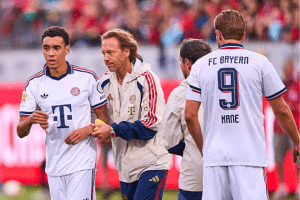
Bayern Munich’s Dominance Is Becoming a Problem for German Football
For decades, Bayern Munich’s dominance has continued to undermine the competitive balance of the Bundesliga. Every now and then, the Bavarians stumble into failure, but those setbacks rarely last long before they recover and embark on another period of domestic supremacy.
The pattern has become increasingly familiar. Bayern may occasionally surrender the Bundesliga crown, but their rivals often appear to be temporary challengers rather than genuine threats capable of consistently disrupting their reign.
That is one reason the Bundesliga has acquired the mocking nickname of “Farmer’s League” among sections of the global football community. The label is largely rooted in the perception that Bayern’s superiority has made the German top flight predictable, with other clubs seemingly competing for the opportunity to dethrone them for only a season before the hierarchy is restored.
Bayern’s dominance also extends beyond Germany. The club remain one of Europe’s most formidable sides, regularly competing deep into the Champions League. Although they failed to win the competition last season, Bayern still reached the semi-finals as Germany’s representative.
Over the past decade, perhaps only Borussia Dortmund have consistently come closest to matching Bayern’s level. Dortmund have remained the club most capable of challenging the Bavarians domestically, although the gap between the two sides has often been visible both on and off the pitch.
Dortmund president Hans-Joachim Watzke recently acknowledged Bayern’s overwhelming influence over German football. He admitted that the Munich giants have dominated the country “in every aspect,” while also highlighting Dortmund’s strong campaign last season, when they collected 73 points.
Yet Watzke believes the balance of power can finally shift.The Dortmund president has insisted that his club are capable of ending Bayern’s dominance and even suggested that the two teams are now operating at a similar sporting level.
In his view, the principal difference between Dortmund and Bayern lies in their financial strength rather than their footballing quality. It is an ambitious claim, particularly from a club president preparing for another title race against the Bundesliga’s established powerhouse.
Confidence is undoubtedly essential in football, especially when attempting to build a squad capable of challenging Bayern over an entire season. But there is a fine line between confidence and premature declarations of superiority.
Watzke’s remarks could easily be interpreted as psychological warfare ahead of the new campaign, but they also risk creating unnecessary pressure on Dortmund. Declaring the two clubs equal before the season has even begun invites scrutiny, particularly when Bayern still possess greater financial power, squad depth and a proven ability to sustain success over many years.
Dortmund’s 73-point campaign was certainly encouraging, but it still reflects the difficulty of competing with Bayern over a full Bundesliga season. If Dortmund genuinely believe they have closed the gap, the strongest response will not come through public statements but through results on the pitch.
Ultimately, Bayern’s dominance will only end when another club can consistently match them rather than challenge them for a single season. Dortmund now have the opportunity to prove Watzke’s confidence was justified. Until then, Bayern remain the benchmark in German football — and the rest of the Bundesliga are still chasing them.